


IBD medicine safety
Content date: 10 November 2026
Biologic and targeted medicines and immunomodulators help control inflammation. Their risks and instructions differ; keep a plan specific to your medicine.
Your next step
Write down your medicine’s name and dose date, and check whom to contact for fever or infection.
Get urgent help: Breathing difficulty or facial swelling, fainting or a severe rash after a dose, fever with severe illness, or sudden chest pain and shortness of breath.
Why do I need an immune treatment?
- In Crohn’s disease and ulcerative colitis, uncontrolled immune activity in the bowel damages its lining. Medicines calm this activity: some target particular inflammatory signals and others act more broadly. The aim is to heal inflammation, prevent flares and reduce the need for steroids and surgery, not simply mask pain.
- Medicines differ in how they are given, how quickly they work and which safety tests they require. Continuing maintenance treatment after improvement helps keep the disease in remission. Your doctor balances medicine risks against uncontrolled inflammation; ask for your medicine’s name, purpose and monitoring plan.
Before the first dose
- You may need tests for tuberculosis, hepatitis B and C and other infections, along with a blood count and liver tests. Tell the team about previous infections, travel or exposure to tuberculosis.
- Review your vaccination record, pregnancy or pregnancy plans, other illnesses and all medicines and supplements. Additional tests depend on the treatment.
What happens at an infusion?
- An infusion alone usually does not require fasting. Staff review your health and tests, then give medicine slowly through a small tube in a vein while monitoring you. Tell the nurse immediately about new symptoms; observation afterwards may be needed.
- Infusion time varies from around half an hour to two hours or more. Read the linked “Biologic infusions: what to expect” guide for preparation, medicine-specific times and aftercare.
Vaccines and pregnancy
- Ideally, complete appropriate vaccinations before treatment. Many non-live vaccines can be given during treatment, but the team decides which and when.
- Do not receive a live vaccine without specialist advice; it may be unsuitable during immunosuppression. Tell the travel clinic your medicine’s name.
- Some IBD medicines are suitable in pregnancy and others are not. Plan early and do not stop treatment yourself. Tell your baby’s doctor about medicines used during pregnancy before vaccination.
Do not rely on symptoms alone
- Attend blood tests for medicine safety and inflammation monitoring even when you feel better. Endoscopy, stool tests or levels of some medicines may be needed.
- If you miss a dose, contact the team for instructions. Do not double a dose or change the interval between doses yourself.
When should I call before a dose?
- If you have fever, a significant infection, are taking antibiotics or have been exposed to a serious infection, contact the team before your next dose so they can decide its timing. Do not delay infection treatment or stop your IBD medicine for a long period without a plan.
- Tell the team before surgery or a major procedure, and about a new rash, bruising or unusual changes.
- Do not stop steroids suddenly even if you develop an infection; seek prompt assessment.
Storage and prevention
- For home injections, learn the injection and storage instructions for your product. Do not freeze it; ask the pharmacist about travel, refrigeration and safe needle disposal.
- Wash your hands, care for your teeth and skin, and use sun protection. Keep up with appropriate preventive screening, including cervical screening when needed.
- Side effects differ between medicines. Read your own medicine’s leaflet; this page does not cover every treatment or risk.
My preventive-care checklist
| Area | What to review with the team |
|---|---|
| Vaccines | Review the local age- and treatment-appropriate schedule, ideally before treatment escalation; check before any live vaccine. |
| Skin and cervical screening | Ask which screening applies to you. Prior thiopurine use can remain relevant even after stopping it. |
| Bone health | Discuss risk assessment, especially with steroid exposure, low weight or fractures. |
| Mood, smoking and pregnancy plans | Bring these up even when bowel symptoms are controlled. |
| Follow-up ownership | Record the next tests, who reviews them and the contact route if results are delayed. |
The screening schedule depends on age, risk and medicine history. Some treatments or previous thiopurine exposure warrant yearly full skin examination; agree your plan rather than applying one schedule to everyone.
Living with IBD
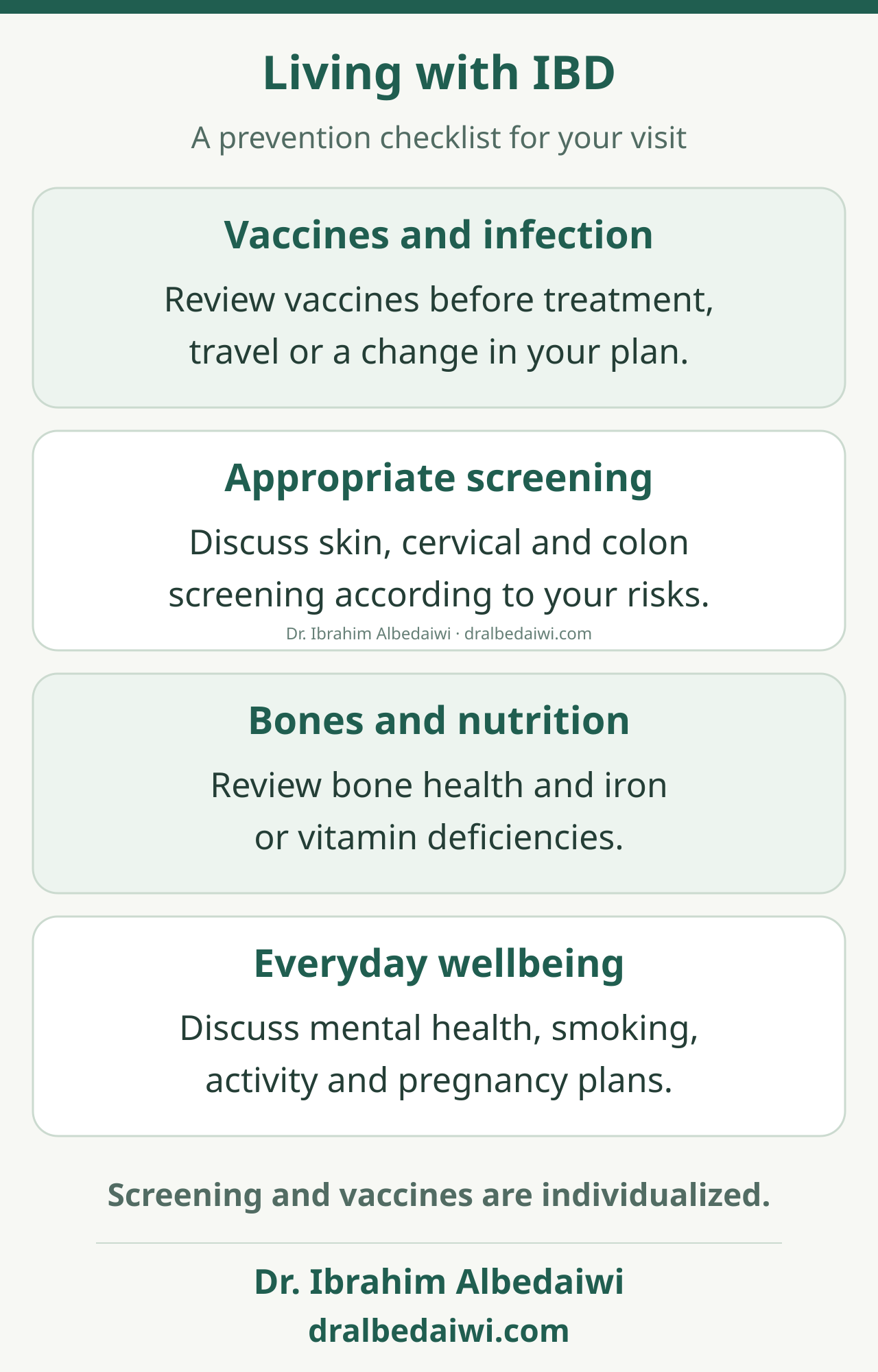
Read the illustration as text
A prevention checklist for your visit
- Vaccines and infection: Review vaccines before treatment, travel or a change in your plan.
- Appropriate screening: Discuss skin, cervical and colon screening according to your risks.
- Bones and nutrition: Review bone health and iron or vitamin deficiencies.
- Everyday wellbeing: Discuss mental health, smoking, activity and pregnancy plans.
Screening and vaccines are individualized.
When to get help
Breathing difficulty or facial swelling, fainting or a severe rash after a dose, fever with severe illness, or sudden chest pain and shortness of breath.
A new fever or infection during treatment, incorrect medicine storage or a missed dose. Contact the team the same day for an infection.
Related guides
Biologic infusions: what to expect
Nutrition with Crohn’s disease and ulcerative colitis
Pregnancy and breastfeeding with bowel and liver disease
Mesalazine / mesalamine medicine card
Budesonide MMX 9 mg / Cortiment