

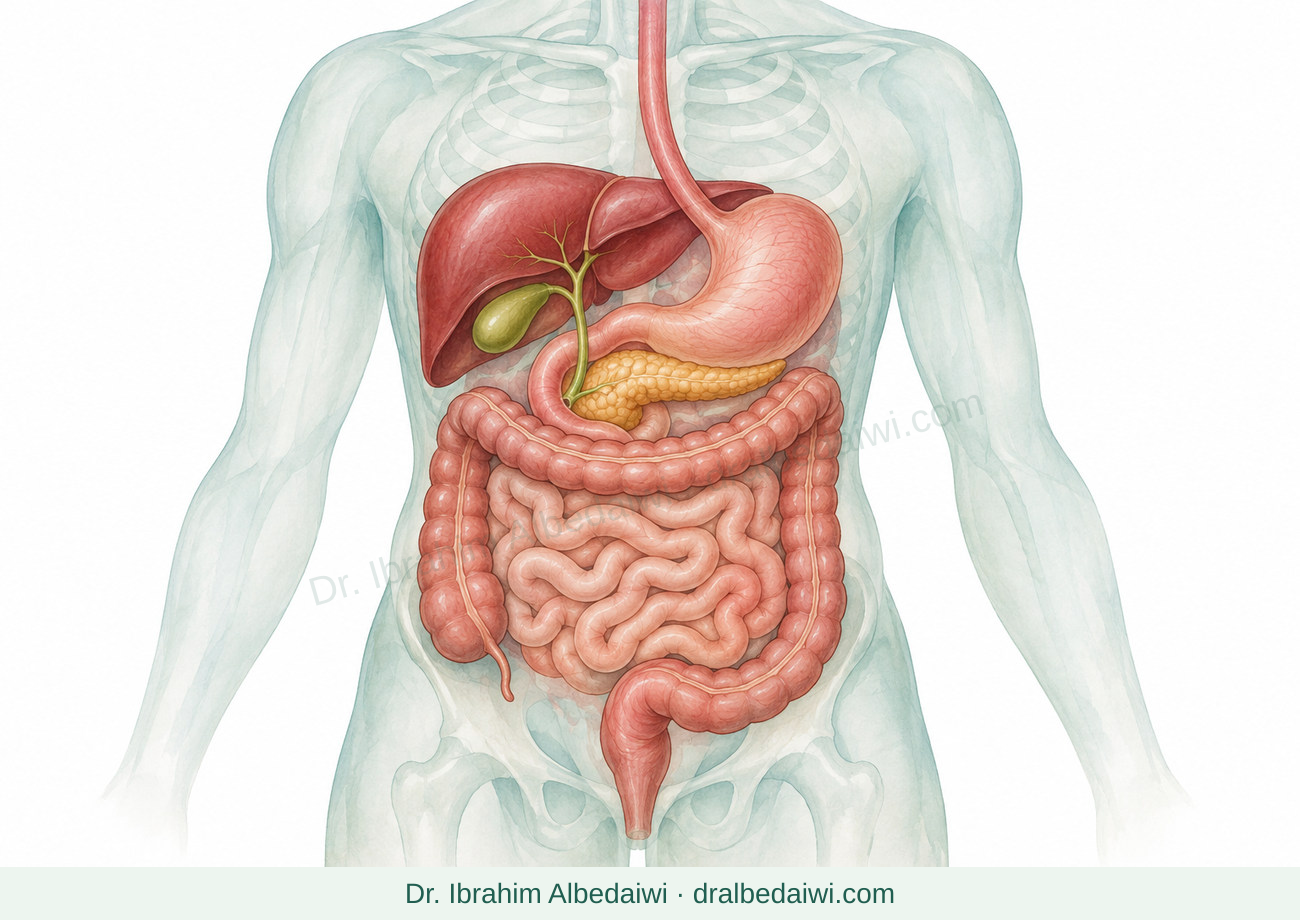

Gastric polyps: understanding the result
Content date: 15 November 2026
Polyps are growths in the stomach lining. Many are benign; the type and tissue result determine removal and follow-up.
Your next step
Keep your endoscopy report and pathology review date.
Get urgent help: Vomiting blood, black tarry stool even without weakness or dizziness, or severe pain after endoscopy: seek urgent medical assessment. Do not wait for several signs to occur together.
What are gastric polyps?
- They may be found incidentally during gastroscopy without symptoms. They differ from colon polyps; “polyp” does not mean cancer. Different types can coexist.
What do the common types mean?
- Fundic gland polyps are often small and benign and may be associated with acid-suppressing medicines. Do not stop a PPI prescribed for a valid indication solely because these polyps were found; review the findings and indication with your clinician.
- Hyperplastic polyps can accompany gastritis or H. pylori. Adenomas may contain precancerous changes and usually require removal and follow-up. Appearance or size alone is not enough to decide.
How are they assessed and treated?
- The clinician may sample the polyp and surrounding lining or remove the polyp endoscopically. H. pylori, atrophy and intestinal metaplasia may need assessment. Different types require different approaches.
- Adenomatous or hyperplastic polyps warrant H. pylori assessment and treatment if positive. The next endoscopy depends on histology, complete removal and the surrounding lining; there is no universal interval.
Before leaving the clinic
- Ask for the polyp type, whether removal was complete, who will review pathology, and whether H. pylori testing or repeat endoscopy is needed. Numerous polyps, younger age or family history may prompt additional assessment.
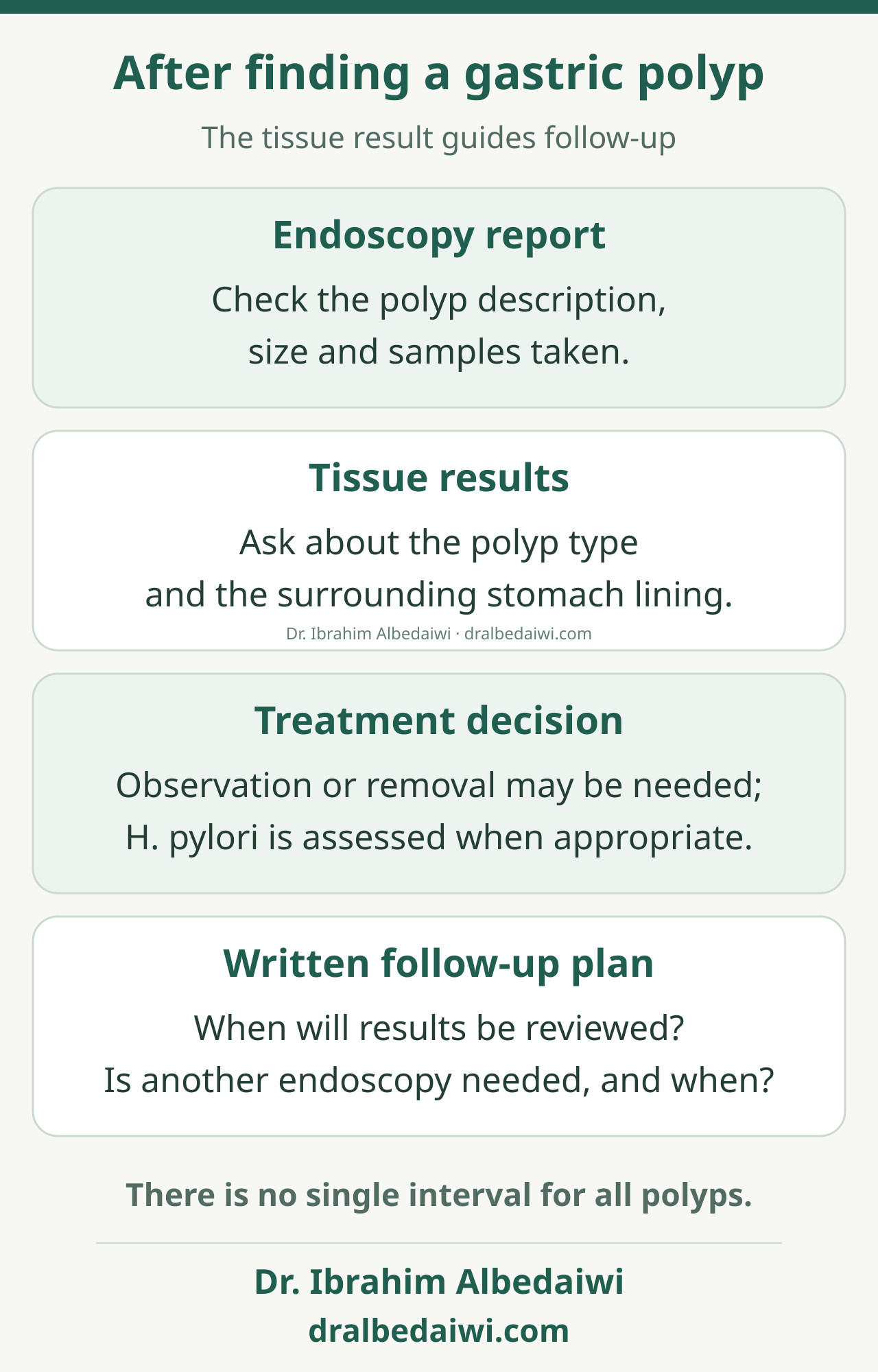
After finding a gastric polyp
Read the illustration as text
The tissue result guides follow-up
- Endoscopy report: Check the polyp description, size and samples taken.
- Tissue results: Ask about the polyp type and the surrounding stomach lining.
- Treatment decision: Observation or removal may be needed; H. pylori is assessed when appropriate.
- Written follow-up plan: When will results be reviewed? Is another endoscopy needed, and when?
There is no single interval for all polyps.
When to get help
Vomiting blood, black tarry stool even without weakness or dizziness, or severe pain after endoscopy: seek urgent medical assessment. Do not wait for several signs to occur together.
Unexplained anaemia or weight loss, or a pathology result not received as planned.