


Understanding faecal calprotectin results
Content date: 14 November 2026
This stool test helps assess and monitor intestinal inflammation; it cannot identify a specific disease or decide treatment by itself.
Your next step
Record the value, units, date and symptoms, and ask when and by whom it will be reviewed.
Get urgent help: Major bleeding, severe pain, fainting or severe dehydration needs emergency care regardless of the result.
What does it measure?
- Calprotectin is a protein that can rise in stool with intestinal inflammation. In the right clinical setting it helps distinguish inflammatory from functional disorders and monitor Crohn’s disease or ulcerative colitis.
- Infection and other conditions can also raise the result, and medicines such as NSAIDs may affect it. Tell your team about medicines; do not stop them for the test without advice. This is not a test to exclude cancer.
Why is one number not enough?
- Laboratory methods and thresholds vary, and diagnostic testing differs from monitoring established disease. Interpret the value alongside symptoms, blood tests, endoscopy or imaging. Your trend can be more useful than comparison with another person.
- A low result reduces the likelihood of some inflammation but does not exclude every cause; the test may be less reliable in Crohn’s confined to the small bowel.
Result and next step
- Improved symptoms and a low result: continue the prescribed plan; do not automatically stop maintenance treatment. Few symptoms but a raised result: confirmation or further assessment may be needed rather than self-escalating medicine.
- Persistent symptoms with a low result: discuss other causes. Severe symptoms, bleeding or dehydration: seek assessment rather than waiting for another test. Your clinician sets the repeat interval for borderline or unexpected results.
Understanding calprotectin
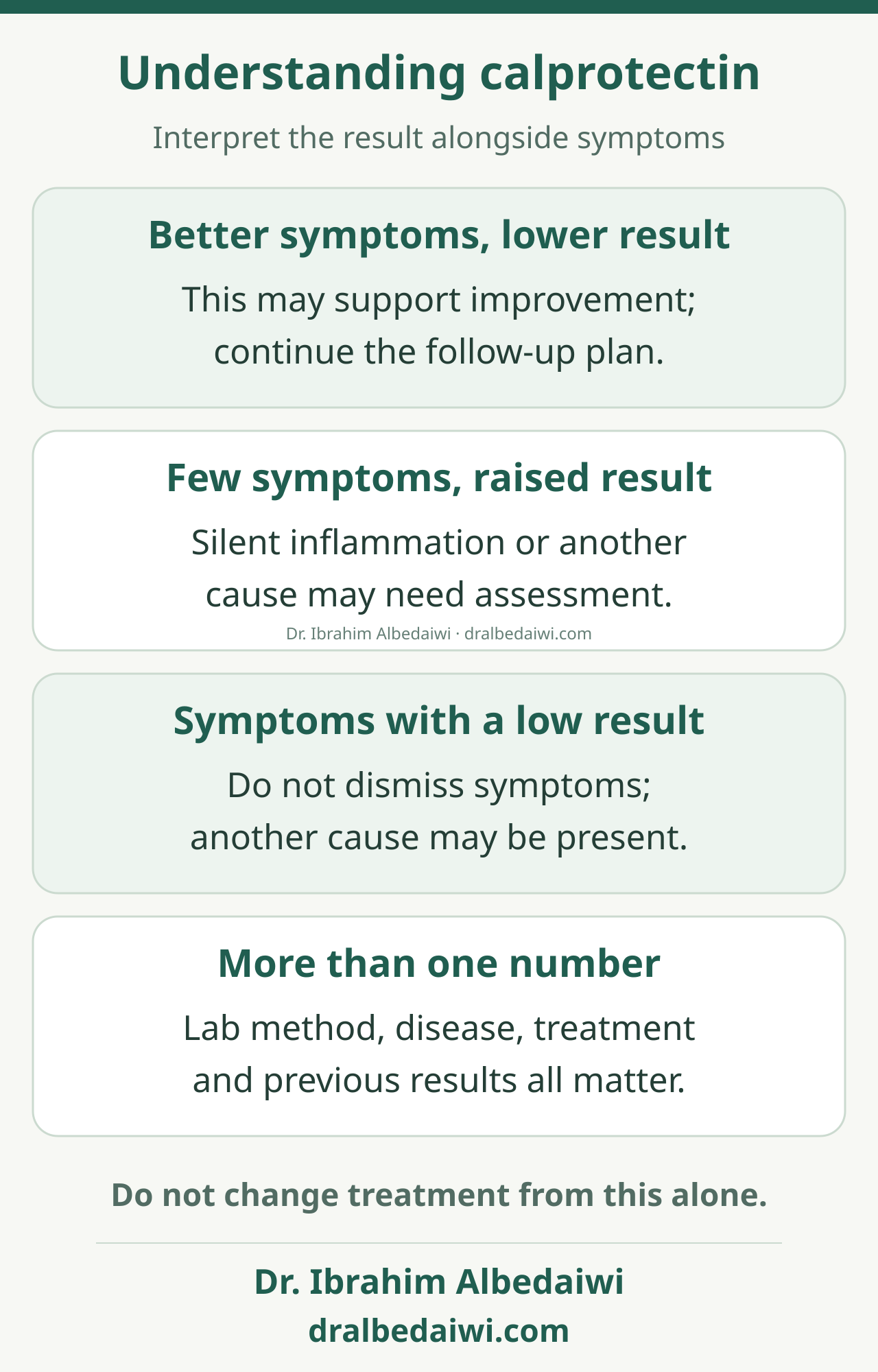
Read the illustration as text
Interpret the result alongside symptoms
- Better symptoms, lower result: This may support improvement; continue the follow-up plan.
- Few symptoms, raised result: Silent inflammation or another cause may need assessment.
- Symptoms with a low result: Do not dismiss symptoms; another cause may be present.
- More than one number: Lab method, disease, treatment and previous results all matter.
Do not change treatment from this alone.
When to get help
Major bleeding, severe pain, fainting or severe dehydration needs emergency care regardless of the result.
New bleeding, weight loss, persistent night-time symptoms, or a raised result without a follow-up plan.